How Japan Taught Me to Love Myself

Since I was ten, my face has been bright red with rosacea. I had tried what felt like many different ways to treat it, prescription creams that helped but also dried out my skin, and so many varieties of face soap. Looking back, it’s pretty obvious I didn’t exhaust my options for cures; but being a kid is tough enough, and in the end, I just decided it wasn’t worth my time. 

However, if I really stopped and checked in with my feelings and self-esteem, I would have realized it was 100% worth my time. It wasn’t until I was seventeen that I looked in the mirror and thought “I hate the way I look, but I can do something about it.” And so I went to the mall and I bought makeup. I fell in love with it, never in my life had I felt more beautiful. I found that if I felt beautiful, I also felt confident and powerful. But only with the makeup on. Once I took it off, my face was red, disgusting, even more so than before. It was clogging my pores and giving me acne, the more I used the more I had to use. My mother even pointed out how worse my skin looked but I didn’t care. I wasn’t going to leave the house without a full face on anyway, so what did it matter if I was covering up more blemishes than I used to be? 

And that’s how it was for four years. 

When I was in Japan I planned a solo hiking trip over my spring break. I’ve lived my whole life surrounded by trees and mountains, rivers and lakes, it’s hard to feel at home if natures not nearby. Therefore, the flat urban landscape of the Chita peninsula where I lived, and the city of Nagoya where I commuted daily, was very difficult for me to live in. When I found my spring break unexpectedly free, one of the first things I did was google “hiking in Japan” and planned a four day, three-night trip to hike a stretch of the Kumano Kodo, an ancient pilgrimage path and UNESCO world heritage site. Its a popular destination with a well-established tourist economy full of wonderful services, including the ability to have your luggage shipped between hostels while you spend the day hiking to the next location. I bring this up not because it was fantastic and I used it, but because I am a college student and couldn’t afford it. I would be carrying my normal school backpack (as opposed to a well-structured hiking pack) with me as I hiked, so I had to pack light. This meant not bringing all of my makeup. 

But it’s me, so of course, I couldn’t do that. I wanted to take selfies that I looked cute in, I wanted to meet new people and feel confident talking to them. I decided to compromise with myself, I would go to the drug store and buy a BB cream, a single, lightweight product that I could use to even my skin tone and call it a day.

Allow me to take this moment to caution travelers to Japan. The makeup section of a Japanese drug store is not equivalent to the makeup section of an American drugstore. In America, one expects to find products ranging from a couple of dollars to maybe fifteen. Anything fancier than that can be picked up in an Ulta or Sephora. A Japanese drugstore is more comparable to Ulta, they carry a range of brands, low and high end. They have 500 yen (five dollar) products and 5,000 yen (fifty dollar) products. I knew this going in.

I was on the hunt for an inexpensive, 1,000 yen BB cream. I started swatching some products on the back of my hand when a sales associate approached me. She was really kind, I told her I was just looking for a BB cream and she showed me one that was not from a makeup company but a skincare brand, Sekkisei. I had never heard of them before and she was honestly a little surprised and explained to me that they are a very popular brand among Japanese women and overseas. She convinced me to let her put some on my face and I knew that I would be walking away buying the product. Not because I instantly fell in love, but because if a sales associate spends that much time with me I start to feel guilty. 

That evening, sitting alone with my purchase, slightly shocked that I so knowingly walked into the sales trap, I turned to google to get the scoop on my purchase. I can’t speak too much to the specifics of the BB cream as I don’t really understand the ingredients and the benefits. But what I do know is that it is surprisingly full coverage, lightweight, and even when it was the only skincare product I was using my face would look less red after taking it off in the evening. 

After falling in love with not only with this product but with the way it made me feel, I began doing further research into Japanese skincare and created a routine for myself, consisting of a double cleanse, exfoliant, toner, and two moisturizers. I was hesitant to invest in so many products, thinking “am I really going to stick to such an intense routine?” But after seeing the results, I can’t imagine not taking care of my skin this way. I haven’t worn a makeup base other than the Sekksei BB cream since buying it, and honestly most days I just put on moisturizer and sunscreen. My friend complimented my foundation the other day to which I responded: “I’m just wearing sunscreen.” That is how much taking care of my skin has affected the way it looks. 

I don’t want to get too preachy at the end, but there is a reason I felt compelled to share my story. Western beauty culture taught me that if I didn’t have flawless skin, just fake it. It left me with worse skin and worse self-esteem. I don’t want to shame any women who honestly loves full coverage foundation on a daily basis, I believe in doing what makes you happy. But if your makeup routine is giving you only temporary happiness and self-love, know that there are other options. 

I always knew I would learn a lot from studying abroad, you can’t live in another culture for so long without picking up some life lessons. Yet never in a million years did I think one of those lessons would be about how to care for myself a little more. Thank you so much to everyone who supported me on my journey overseas, and to the sales associate who roped me into paying 3,000 yen for a BB cream. 
Japan Transit Apps

Hi everyone! Today I’ll be talking about an absolute lifesaver for living in Japan, transit apps. It was only my second or third day here that my host mother told me I wouldn’t survive without Yahoo Transit and, she was right. I’m going to go in depth about the two I use most often, Yahoo Transit and Jorudan, as well as quickly gloss over Google maps. All of these apps are available on Android and iPhone, and have desktop versions as well!

Google Maps:

I would be lost constantly without google maps, I frequently use it for walking directions. But, when it comes to timetables, at least in Japan it severely falls short. I was on a weekend trip with a friend who had done most of the planning and she was giving me options for our train the next day; saying there were only two options before having to wait several hours. That didn’t seem right to me, so I double checked on Yahoo Transit and sure enough, there were a lot more trains available. When it comes to making transit plans, I don’t recommend it.

Yahoo Transit and Jorudan

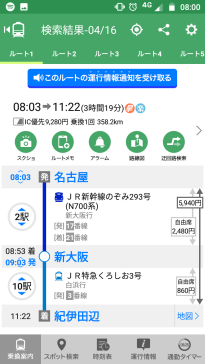
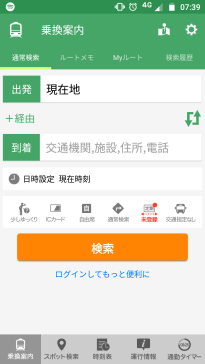
According to my host mom, Yahoo Transit is on every Japanese phone, nobody lives without it. I can’t speak for the accuracy of that statement, but it sounds pretty reasonable to me. Between this and Jorudan, I find Yahoo to be much more user-friendly despite the biggest catch:

screenshot_20190416-074000

It’s entirely in Japanese. This might not be the worst for someone trying to learn the language, but I’m sure it puts a damper on things if you are not. Not only is it in Japanese in terms of reading, but the search function doesn’t understand roman characters, so you need a Japanese keyboard installed to input stations names as well. The functions are very straight forward though, and easy to navigate if you understand them.

Okay, maybe I haven’t convinced you. That’s fine, that’s why I also like Jorudan.

screenshot_20190416-075036

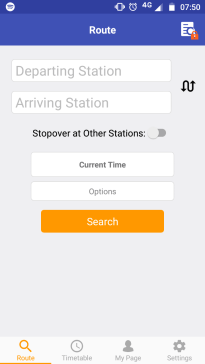
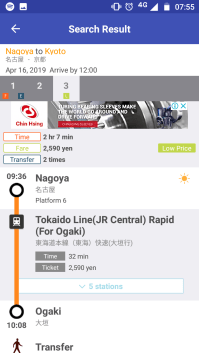
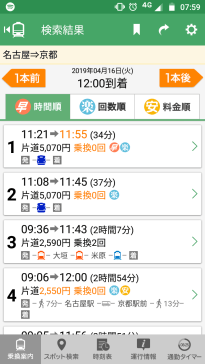
Unlike Yahoo, this app is entirely in English and on the surface looks pretty much the same. Let’s do a quick search to highlight the differences. I’m going to do the same search from Nagoya to Kyoto with both of them, and set the time to arrive at noon, today. It just so happens that the main stations in Nagoya and Kyoto are called Nagoya Station and Kyoto Station, so that makes this search easy. To Google map’s credit, if you’re, for example, trying to get to a movie theater on the other side of the city and don’t know which station you should go to, it can tell you that information and help you figure out where you need to go. These apps can only tell you how to go where you know you want to. Anyway, let’s hit search on both these apps.

screenshot_20190416-075427

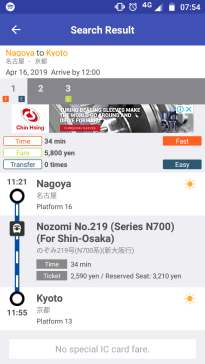
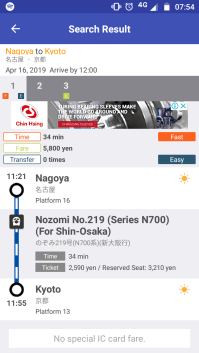
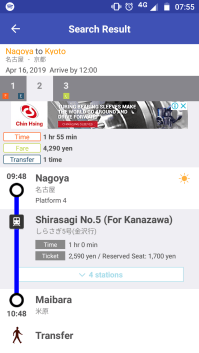
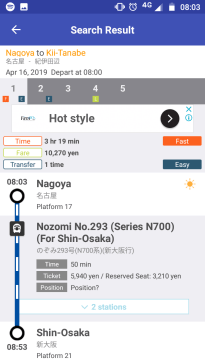
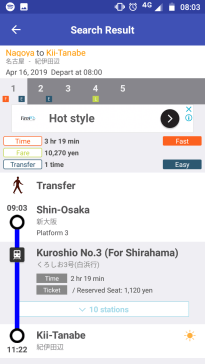
When you search with Jorudan, it has the option numbers listed towards the top, as you can see here it’s given three routes. The orange, blue, and green boxes you see are shorthand for fastest time, easiest route (least amount of transfers), and cheapest ticket. The default settings have it organized by fastest time, but you can change this. If you click on the different numbers it will show the details of all three route options.

screenshot_20190416-075427-1     screenshot_20190416-075510     screenshot_20190416-075521

As you can see, each route provides information in regards to departure and arrival time, cost, which platforms you get on and off at, and an expandable list of the station names that come before your stop. A quick note, if you’re searching on the Jorudan website, it will not include the platform numbers, and say that such information is available for paid members. Don’t fall for this, as the information is right there on the app version. Knowing your platform numbers in advance is super helpful, especially when transfers are involved.

Alright, let’s move on to what Yahoo has to offer and then further compare the two.

screenshot_20190416-075921     screenshot_20190416-075925

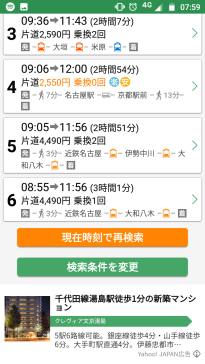
Now, this is the same exact search parameters as with Jorudan, and already you can see not only the app’s formatting is extremely different, but also the search result has been doubled. This result screen gives a quick breakdown of the different routes, times, costs, transfers, and with the pictographs you can tell if it’s a shinkansen (1 and 2), above ground trains (3, 5, and 6), or even a bus (4). This app also uses the same shorthand as Jorudan, with orange, blue and yellow circles representing fastest time, easiest route, and cheapest ticket.

screenshot_20190416-080003

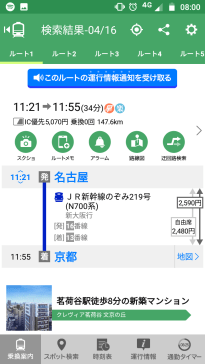
Clicking an option gives you further details such as platform numbers, train names, an expandable list of stations before your stop, and ticket information. The arrows represent what part of the route a certain ticket covers. Here’s a different search for a better example of this.

screenshot_20190416-080042

If you read my How To Ride The Shinkansen post, you know about fare and seat tickets. The yen amount that has arrows from top to bottom is the fare ticket, the other two are the seat tickets. Jorudan does a similar thing, but the formatting looks more like easily missed fine print so be careful and always refer to the fare listed at the top.

screenshot_20190416-080305     screenshot_20190416-080315

You may have noticed by now that the fares between these apps for the same searchers are a little different. That’s because although I made the times the same, I was searching on the default settings. Yahoo uses a default of unreserved seats and Jorudan uses reserved seats. Reserved seats are a little more expensive because you are guaranteed a seat, whereas you may be left standing if you have an unreserved ticket.

And that’s it! These apps are pretty straightforward. I have a preference for Yahoo because of the way it shows a summary of all the search results and is more flexible in the options it gives, but honestly, they’re both fine and will help you get to where you need to go! Also, with these apps, you can input future dates and times, to plan for trips. I used them to figure out my entire trip to Wakayama almost two months in advance. I hope someone found this helpful, happy travels!