How Japan Taught Me to Love Myself

Since I was ten, my face has been bright red with rosacea. I had tried what felt like many different ways to treat it, prescription creams that helped but also dried out my skin, and so many varieties of face soap. Looking back, it’s pretty obvious I didn’t exhaust my options for cures; but being a kid is tough enough, and in the end, I just decided it wasn’t worth my time. 

However, if I really stopped and checked in with my feelings and self-esteem, I would have realized it was 100% worth my time. It wasn’t until I was seventeen that I looked in the mirror and thought “I hate the way I look, but I can do something about it.” And so I went to the mall and I bought makeup. I fell in love with it, never in my life had I felt more beautiful. I found that if I felt beautiful, I also felt confident and powerful. But only with the makeup on. Once I took it off, my face was red, disgusting, even more so than before. It was clogging my pores and giving me acne, the more I used the more I had to use. My mother even pointed out how worse my skin looked but I didn’t care. I wasn’t going to leave the house without a full face on anyway, so what did it matter if I was covering up more blemishes than I used to be? 

And that’s how it was for four years. 

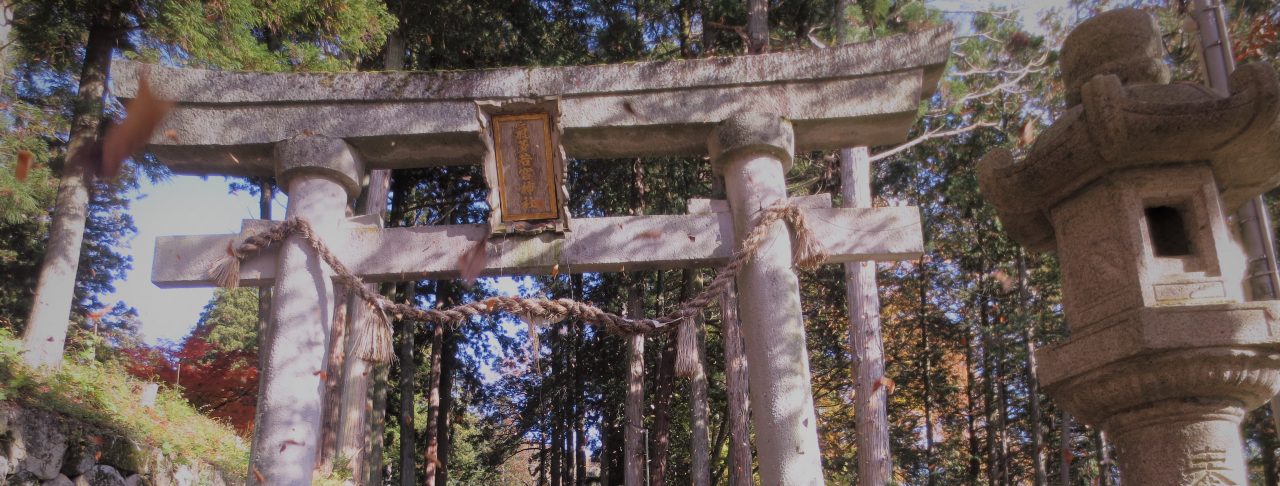
When I was in Japan I planned a solo hiking trip over my spring break. I’ve lived my whole life surrounded by trees and mountains, rivers and lakes, it’s hard to feel at home if natures not nearby. Therefore, the flat urban landscape of the Chita peninsula where I lived, and the city of Nagoya where I commuted daily, was very difficult for me to live in. When I found my spring break unexpectedly free, one of the first things I did was google “hiking in Japan” and planned a four day, three-night trip to hike a stretch of the Kumano Kodo, an ancient pilgrimage path and UNESCO world heritage site. Its a popular destination with a well-established tourist economy full of wonderful services, including the ability to have your luggage shipped between hostels while you spend the day hiking to the next location. I bring this up not because it was fantastic and I used it, but because I am a college student and couldn’t afford it. I would be carrying my normal school backpack (as opposed to a well-structured hiking pack) with me as I hiked, so I had to pack light. This meant not bringing all of my makeup. 

But it’s me, so of course, I couldn’t do that. I wanted to take selfies that I looked cute in, I wanted to meet new people and feel confident talking to them. I decided to compromise with myself, I would go to the drug store and buy a BB cream, a single, lightweight product that I could use to even my skin tone and call it a day.

Allow me to take this moment to caution travelers to Japan. The makeup section of a Japanese drug store is not equivalent to the makeup section of an American drugstore. In America, one expects to find products ranging from a couple of dollars to maybe fifteen. Anything fancier than that can be picked up in an Ulta or Sephora. A Japanese drugstore is more comparable to Ulta, they carry a range of brands, low and high end. They have 500 yen (five dollar) products and 5,000 yen (fifty dollar) products. I knew this going in.

I was on the hunt for an inexpensive, 1,000 yen BB cream. I started swatching some products on the back of my hand when a sales associate approached me. She was really kind, I told her I was just looking for a BB cream and she showed me one that was not from a makeup company but a skincare brand, Sekkisei. I had never heard of them before and she was honestly a little surprised and explained to me that they are a very popular brand among Japanese women and overseas. She convinced me to let her put some on my face and I knew that I would be walking away buying the product. Not because I instantly fell in love, but because if a sales associate spends that much time with me I start to feel guilty. 

That evening, sitting alone with my purchase, slightly shocked that I so knowingly walked into the sales trap, I turned to google to get the scoop on my purchase. I can’t speak too much to the specifics of the BB cream as I don’t really understand the ingredients and the benefits. But what I do know is that it is surprisingly full coverage, lightweight, and even when it was the only skincare product I was using my face would look less red after taking it off in the evening. 

After falling in love with not only with this product but with the way it made me feel, I began doing further research into Japanese skincare and created a routine for myself, consisting of a double cleanse, exfoliant, toner, and two moisturizers. I was hesitant to invest in so many products, thinking “am I really going to stick to such an intense routine?” But after seeing the results, I can’t imagine not taking care of my skin this way. I haven’t worn a makeup base other than the Sekksei BB cream since buying it, and honestly most days I just put on moisturizer and sunscreen. My friend complimented my foundation the other day to which I responded: “I’m just wearing sunscreen.” That is how much taking care of my skin has affected the way it looks. 

I don’t want to get too preachy at the end, but there is a reason I felt compelled to share my story. Western beauty culture taught me that if I didn’t have flawless skin, just fake it. It left me with worse skin and worse self-esteem. I don’t want to shame any women who honestly loves full coverage foundation on a daily basis, I believe in doing what makes you happy. But if your makeup routine is giving you only temporary happiness and self-love, know that there are other options. 

I always knew I would learn a lot from studying abroad, you can’t live in another culture for so long without picking up some life lessons. Yet never in a million years did I think one of those lessons would be about how to care for myself a little more. Thank you so much to everyone who supported me on my journey overseas, and to the sales associate who roped me into paying 3,000 yen for a BB cream. 
Japan Transit Apps

Hi everyone! Today I’ll be talking about an absolute lifesaver for living in Japan, transit apps. It was only my second or third day here that my host mother told me I wouldn’t survive without Yahoo Transit and, she was right. I’m going to go in depth about the two I use most often, Yahoo Transit and Jorudan, as well as quickly gloss over Google maps. All of these apps are available on Android and iPhone, and have desktop versions as well!

Google Maps:

I would be lost constantly without google maps, I frequently use it for walking directions. But, when it comes to timetables, at least in Japan it severely falls short. I was on a weekend trip with a friend who had done most of the planning and she was giving me options for our train the next day; saying there were only two options before having to wait several hours. That didn’t seem right to me, so I double checked on Yahoo Transit and sure enough, there were a lot more trains available. When it comes to making transit plans, I don’t recommend it.

Yahoo Transit and Jorudan

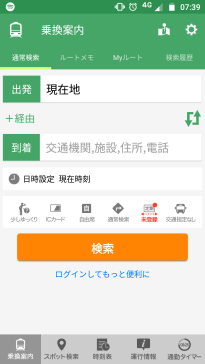
According to my host mom, Yahoo Transit is on every Japanese phone, nobody lives without it. I can’t speak for the accuracy of that statement, but it sounds pretty reasonable to me. Between this and Jorudan, I find Yahoo to be much more user-friendly despite the biggest catch:

screenshot_20190416-074000

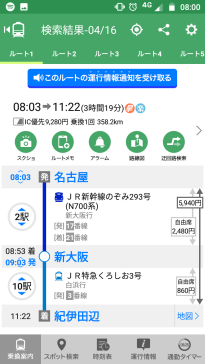
It’s entirely in Japanese. This might not be the worst for someone trying to learn the language, but I’m sure it puts a damper on things if you are not. Not only is it in Japanese in terms of reading, but the search function doesn’t understand roman characters, so you need a Japanese keyboard installed to input stations names as well. The functions are very straight forward though, and easy to navigate if you understand them.

Okay, maybe I haven’t convinced you. That’s fine, that’s why I also like Jorudan.

screenshot_20190416-075036

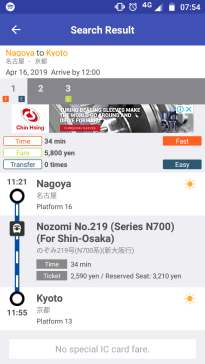
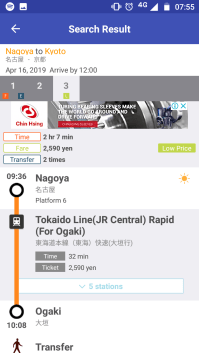
Unlike Yahoo, this app is entirely in English and on the surface looks pretty much the same. Let’s do a quick search to highlight the differences. I’m going to do the same search from Nagoya to Kyoto with both of them, and set the time to arrive at noon, today. It just so happens that the main stations in Nagoya and Kyoto are called Nagoya Station and Kyoto Station, so that makes this search easy. To Google map’s credit, if you’re, for example, trying to get to a movie theater on the other side of the city and don’t know which station you should go to, it can tell you that information and help you figure out where you need to go. These apps can only tell you how to go where you know you want to. Anyway, let’s hit search on both these apps.

screenshot_20190416-075427

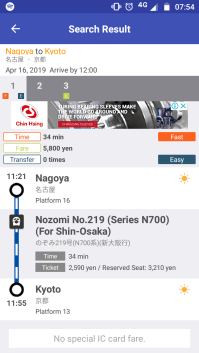
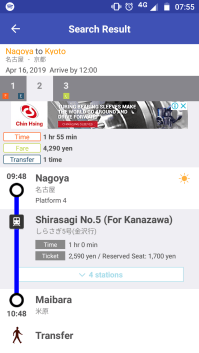
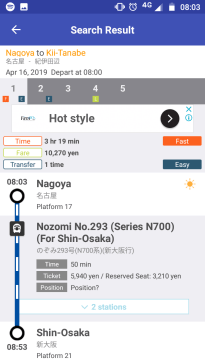
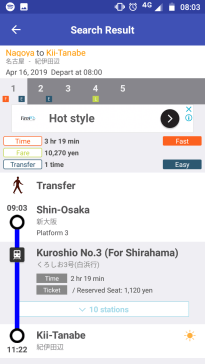
When you search with Jorudan, it has the option numbers listed towards the top, as you can see here it’s given three routes. The orange, blue, and green boxes you see are shorthand for fastest time, easiest route (least amount of transfers), and cheapest ticket. The default settings have it organized by fastest time, but you can change this. If you click on the different numbers it will show the details of all three route options.

screenshot_20190416-075427-1     screenshot_20190416-075510     screenshot_20190416-075521

As you can see, each route provides information in regards to departure and arrival time, cost, which platforms you get on and off at, and an expandable list of the station names that come before your stop. A quick note, if you’re searching on the Jorudan website, it will not include the platform numbers, and say that such information is available for paid members. Don’t fall for this, as the information is right there on the app version. Knowing your platform numbers in advance is super helpful, especially when transfers are involved.

Alright, let’s move on to what Yahoo has to offer and then further compare the two.

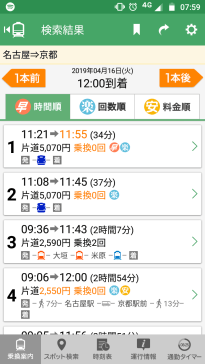
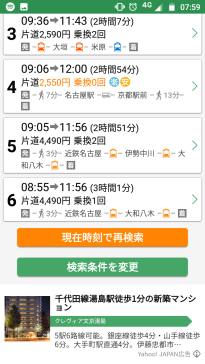
screenshot_20190416-075921     screenshot_20190416-075925

Now, this is the same exact search parameters as with Jorudan, and already you can see not only the app’s formatting is extremely different, but also the search result has been doubled. This result screen gives a quick breakdown of the different routes, times, costs, transfers, and with the pictographs you can tell if it’s a shinkansen (1 and 2), above ground trains (3, 5, and 6), or even a bus (4). This app also uses the same shorthand as Jorudan, with orange, blue and yellow circles representing fastest time, easiest route, and cheapest ticket.

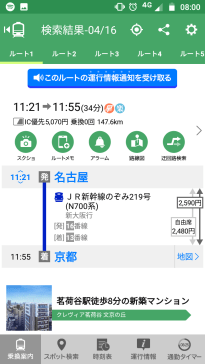
screenshot_20190416-080003

Clicking an option gives you further details such as platform numbers, train names, an expandable list of stations before your stop, and ticket information. The arrows represent what part of the route a certain ticket covers. Here’s a different search for a better example of this.

screenshot_20190416-080042

If you read my How To Ride The Shinkansen post, you know about fare and seat tickets. The yen amount that has arrows from top to bottom is the fare ticket, the other two are the seat tickets. Jorudan does a similar thing, but the formatting looks more like easily missed fine print so be careful and always refer to the fare listed at the top.

screenshot_20190416-080305     screenshot_20190416-080315

You may have noticed by now that the fares between these apps for the same searchers are a little different. That’s because although I made the times the same, I was searching on the default settings. Yahoo uses a default of unreserved seats and Jorudan uses reserved seats. Reserved seats are a little more expensive because you are guaranteed a seat, whereas you may be left standing if you have an unreserved ticket.

And that’s it! These apps are pretty straightforward. I have a preference for Yahoo because of the way it shows a summary of all the search results and is more flexible in the options it gives, but honestly, they’re both fine and will help you get to where you need to go! Also, with these apps, you can input future dates and times, to plan for trips. I used them to figure out my entire trip to Wakayama almost two months in advance. I hope someone found this helpful, happy travels!


How to Ride the Shinkansen

Last week, I rode the shinkansen, Japanese bullet train, for the first time. I figured it would be a pretty straightforward process, and it is, but there are definitely a few things that I wish I knew in advance. Actually, just one thing. And then a bunch of other things I had to google in order to have the knowledge in advance. So, for anyone else searching for that knowledge, here’s my take it on it.

Before I dive in, this is going to be about buying tickets in Japan and how to use the tickets. For those coming from overseas just to sightsee, you have the option of purchasing a Japan Rail Pass. The exact price varies depending on location and how many days, with the average being around 200 USD for seven days. These passes are through the different JR (Japan Rail) companies and cover almost all JR trains and buses (note that city subways are NOT operated by JR). My one-way shinkansen ticket from Nagoya to Shin-Osaka was almost 6000円 (~$55), so if you’re planning cover a lot of ground it definitely is worth it! More information can be found here.

Buying a Ticket:

This is one thing I researched myself, and the advice I’m about to give is contrary to what I found others suggesting. However, I am of the opinion that the easiest way to buy a shinkansen ticket is at a machine and not at a counter with a person. Especially if you do some prior planning with a Japan transit app. The main reason that I found other people recommending going to a person is because of “how confusing” shinkansen can be, but I would like to dispel this rumor. There are only three simple things you need to know before approaching a ticket machine:

1) Names of shinkansen:

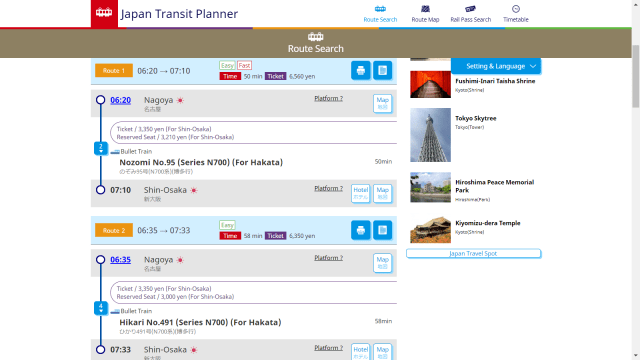
When using a transit planner you’ll see something like this:

Screenshot (39)

As you can see, both of these options are on a bullet train, but one of them says “Nozomi No. 95” and the other says “Hikari No. 491”. Depending on where you’re going, you may see a variety of other names, but the difference remains the same: speed and price. If you compare the two, the Nozomi train makes two stops less and gets in 23 minutes earlier. If you want a reserved seat it’s 210円 more, but non-reserved seats are the same price for both trains.

2) Seats:

Seats come in three kinds: reserved, non-reserved, and green car. Reserved means just that, you reserve an actual seat and are guaranteed to sit in it. Non-reserved means that the seats in that cabin are first-come-first-served, and you might end up standing. These tickets are the cheapest. Green car is code for first class, where there is more room per seat and fewer people in general, but the difference in price can be 2-3000円 more.

3) Do you want to ride in a smoking or non-smoking car?  

Once you know what ticket you want to buy, approach a shinkansen ticket machine. These can be found in any train station where you can board a shinkansen, and even some bigger stations where you can’t, for example, there’s a couple in Nagoya’s Kanayama station. At a shinkansen ticket machine, you can, of course, buy shinkansen tickets, but also transfer tickets to JR limited express trains. These are a little nicer than your average JR train and require an additional seat fee. Much like shinkansen you can buy a reserved or unreserved seat. I mention this because when I bought my ticket I also bought a transfer ticket for a limited express train. Once at the machine, there’s a button on the top right of the screen to change the language. You’ll then be given the choice of searching for a reserved shinkansen ticket, a non-reserved ticket, or to purchase tickets using a route search. I believe if you search for a reserved or non-reserved ticket you will be asked if you want to buy a transfer ticket as well, but I just chose to use the route search. With that option, you input the starting station and final station – for me, this was Nagoya and Kii-Tanabe – dates, and time. It will then show you some itinerary options, pick the one that works best for you, or if you’re using a transit app, matches that itinerary. Pay with a credit card or cash and receive your tickets!

You will always receive at least two tickets, there will be more if you bought transfer tickets as well. One of these will be your “ticket”, which is the cost of getting from point a to point b. My ticket read Nagoya to Kii-Tanabe. The other ticket(s) is your seat ticket, this is the cost of being on the train. Because I transferred, I had two separate seat tickets, one for a shinkansen from Nagoya to Shin-Osaka, and one for a JR limited express from Shin-Osaka to Kii-Tanabe.

Riding the Shinkansen:

This is the part that messed me up on my travels. It’s super straight forward if you know what to do, but if you don’t then a ticket machine will yell at you. And the businessmen trying to have an easy commute will be annoyed at you when you have to push past them to ask a station attendant why you can’t get through.  

Anyway, what you do is you take your ticket, and your seat ticket, and put them stacked on top of each other into the ticket machine. Now the gates will let you through and spit the tickets out on the other side, where you collect them. Then, as you exit at the end of your trip, just repeat this process. Unless you’re transferring, then you add your new seat ticket onto the pile and put all three into the machine, this time it will only spit back your new seat ticket and fare ticket.

As for actually riding the shinkansen, find either the car number your reserved ticket corresponds to or a car marked “non-reserved.” If you do have a non-reserved ticket, I recommend arriving early so that you can be near the front of the line and have a better chance of getting a seat. The seats have a very large amount of legroom, designed for anyone traveling with a large suitcase to be able to fit that in front of them. If you’re not traveling with one, enjoy the room!

And that’s all! Happy travels!

Being Sick in Japan

I was sick for the majority of last semester. I resisted going to the doctor for the first month or so of my cold; it wasn’t until I felt too sick to go to class that I finally gave in to get a doctor’s note for an excused absence. Now, I know it sounds childish to not want to go to the doctor, in fact, my host family asked me several times why I wouldn’t just go. My host sister, in particular, was very confused by my behavior. I used it as an opportunity to explain the difference in American and Japanese health care to them, making the excuse that my resistance was just culturally ingrained in my being due to higher healthcare costs. Well, that and dealing with colds by buying Dayquil and continuing with my life. I think that Dayquil may be illegal here, and many of my close friends and family have probably heard me say that it is, but in fact-checking myself for this post I couldn’t find a clear answer. Definitely, some over the counter and prescription medicines legal in the United States are not in Japan, and those traveling have to be careful what they bring. According to the US Embassy in Japan’s website “Stimulant drugs including methamphetamines and amphetamines, some prescription medications such as Adderall; Pseudoephedrine, [and] Codeine” are all illegal.

But I digress.

The truth behind my refusal to go to the doctor was as childish as my actions: I was scared. This fear stemmed from my constant companion, the language barrier. In Japanese, the word for hospital is byouin (spelled 病院 in kanji or びょういん in hiragana). Whenever my host mother, Megumi asked if I wanted to go to the doctor she asked if I wanted to go to the byuoin, and I couldn’t fathom what kind of set up or process would be involved with going to a hospital for just a cold. Because I have anxiety and new situations scare me – which might be a shock to any reader of a study abroad blog – I did not want to find out. Finally, though, I didn’t have much of a choice, and I was so sick that I didn’t really care anymore. And that’s when the truth was revealed. The Japanese concept of a hospital is not the same as mine.

When I told Megumi I wanted to go, she took my national health insurance card to reserve an appointment time. I think walk-ins are also welcome but both times I’ve gone she’s done this. When we arrived I expected a large hospital like the one near Nanzan University. Nope, not even close. We pull up to a small building that says “clinic” or actually “クリニック” which is pronounced “kurinikku” or, you know, clinic (good ol’ katakana words). I don’t know why in spoken language clinics are called hospitals, and I tried to ask Megumi and she just didn’t understand the question. I guess, just as many Americans can’t distinguish between a yam and a sweet potato, the concept of a hospital and a clinic are one and the same.

When we walked in there was a big room, the reception desk was in front, and the waiting area was to the left. Megumi let them know we were there and we sat down. In front of all the chairs was some shelving with various health pamphlets and magazines. Typical doctor’s office stuff. When my name was called I assumed that I was about to be brought into a room. Thankfully Megumi was there to direct me because I was actually being called to walk around to the other side of the shelf and sit in those chairs. After another five or so minutes I was taken to see the doctor. The appointment was pretty quick, he asked me a couple questions about my symptoms, listened to my heart, asked me some more questions that felt random (I later realized they were to determine what medicine to prescribe), and then we left. I paid for the appointment then went next door to the pharmacy for the medicine he prescribed, and went home.

I was so excited to take the medicine because I felt awful. Before I did though, I tried to look them up and figure out what was given to me, but I couldn’t find anything. So like all my fellow CJS students who told me about their adventures with being sick, I just shrugged and took the stuff. And when I did, boy did I feel good, like really good. The kind of good that you laugh to yourself and think “what in the world did I just take?” So the search began again, and after a while, I found one of the most useful sites for living in Japan, kusuri no shiori or drug information sheet (link). On this website, I was able to find all but one of the drugs with English information, including ingredients, usages, side effects, and pill images/descriptions. The other one was available in Japanese only, so then I used google translate to get the gist of what it was. And what it was was an opioid, which explained a lot.

I took the meds (although I stopped the opioid after the worst of the cold past because I still needed my brain for school), and got completely better except for my cough, which persisted. A month or so later I had a really bad cold, again. And just in time for finals! But this time when we went to the “hospital” the doctor wanted to run some more tests in case I had pneumonia (spoiler: I didn’t and am a-okay). First I took a breath test which was really complicated to figure out how to do. The poor technician and Megumi spent about five minutes making sure I understood how it worked. I had to exhale, put this tube in my mouth, inhale, then exhale again into the tube. And then, the really hard part, there was a tri-color scale. I can’t remember the exact colors but let’s say they went from red to green to blue. The important thing was to exhale with enough force to get a line into the green and keep it there. It was so difficult, and what made it harder was that the tech and Megumi were very loudly cheering me on. They said things like “you can do it” and “yes, green, green green green!” which just made me want to laugh. But when I failed, they just cheered harder the next time. Even with their strange cheering, I did it, and I can officially confirm I don’t have asthma. Next, I was taken in for a chest x-ray. Which was so much simpler than when I had to get one to come to Japan – a requirement by Nanzan to make sure no one had TB. I say that because when I had it done in the states I had to change into a hospital gown and stand in very uncomfortable ways. Here they didn’t make me change, and had me stand in strange, but not uncomfortable ways. As I already said, my new cold wasn’t serious; the doctor gave me different meds and I am now cough and cold free.

So how much did two doctors visits, some testing, and ~6 different medicines cost me? For starters, I have national health insurance, it’s legally required that anyone on a long-term visa enroll. The cost varies depending on the place of residence, and as a student, I receive a reduced rate. I was hoping to make an educational post about signing up for this, but I wouldn’t really know what to write. I went to the ward office with Megumi and she did all the talking. I signed where I was told and that was that. The cost for me was 5700 yen the first month and 1000 yen a month after that. Which averages to about 1633 yen a month for my whole stay, or 16.33 USD. The first doctor visit was ~1000 yen, and the medicine was 1100 yen, so ~2100 yen or US $21 for a doctor’s visit and medicine. The second visit with the additional tests was 2000 yen and the medicine was 1310 yen, totaling 3310 yen or about $33.10. I don’t want to make a big political statement about healthcare systems and costs, but I do have to say it was a little frustrating having to pay $21 when I just a had a cold, where in the US I can pick up DayQuil for about 8 dollars. However, the second time when there was a concern it could be more than just a cold, it was nice paying only ~$30 to make sure I wasn’t going to die in a foreign country.

On the subject of healthcare cost, over the counter medicine is really expensive here. I take ibuprofen semi-frequently because I get a lot of headaches. I wasn’t concerned because I was told by my professors and the internet that ibuprofen can be bought here, no worries. What they failed to mention is that ibuprofen costs about 20 dollars for only 36 gel capsules, or only 12 doses if you take 600 mg (the recommended dosage is 400mg, consult your doctor before taking more). For comparison, $20 gets you 200 brand name, gel capsules in America. So if that’s something you take, consider bringing the legal import limit with you. I plan to write another post about bringing medicine into Japan because I did that. And I could have used some help from the internet.

Convenient is in the name

And what name might that be? Why, convenient stores of course! Or, as called in Japanese “conbini” (コンビニ). If you think that sounds suspiciously like a shortened version of “convenient” then you’d be correct! Japanese has taken many modern words from foreign languages. For a comedic take on this concept allow me to redirect you to one of my favorite videos on the internet here. It’s a form of comedy called “rakugo” and the performer, Sunshine, is the only foreigner to have ever studied it. Which is pretty impressive to me that any foreigner studied comedy in a second language because that is hard. Very, very hard.

But I digress, I came to talk about conbinis because I love them and will definitely miss them when I return to the States. There are a lot of different convenience store chains here, but from what I’ve observed 7/11, Lawsons, and Family Mart seem to be the biggest. Although there’s this one called “short stop” and I love making jokes when we pop in there on a road trip. Just, uh, making a short stop along the way~ …Yeah, my host family doesn’t understand because, English.

Anyway, if you’re a foreigner planning to come to Japan, get ready to walk into a 7/11 at least once. Japan is a cash society, which means a lot of places, especially restaurants, won’t except a credit or debit card. In Nagoya, there’s only one train stop I know of that will let you pay for a ticket with a card, everywhere else is cash only. 7/11 comes into play because you are almost guaranteed to find an atm there that accepts foreign cards. Some Lawsons do too, but I have found 7/11 to have a more reliable track record. The atm fee isn’t that bad either, about 200 yen (USD $2). From my understanding, the exchange rate is extremely fair, too. I’ve never actually done the math to see what they’re giving me, but just by looking at the numbers it seems very close to what Google says (1 USD = ~113 yen).

Second, convenient store food here is actually good. I eat conbini food at least once a week for lunch, usually more. And it’s not because I don’t have any other options, it’s just that conbini food tastes good and is a decent price. And that’s the just the premade food. If you have a sweet tooth and the ability to digest dairy, Japanese ice cream snacks are the best. It takes a lot of willpower to not buy one every single time I walk into a conbini.

But here’s what really inspired me to write this post: Anyone who lives in Japan for more than three months legally has to enroll in Japan’s national health care plan. As I am here for nine months, that includes me. I can’t speak too much on how the enrollment process works because my host mom did most of it for me. But, I finally got the first bill, and then promptly buried it under a stack of comics in my room.

Oh no, suddenly, it’s the day before it’s due and I haven’t paid it, how stressful! Except not! Because how does one pay for their national health insurance in Japan? By bringing the bill to the conbini and paying it right there and then. You just take it to the counter as if you were buying something, but instead, you’re paying a bill. And, since most conbinis are open 24 hours, just go whenever is convenient for you. I may or may not have a bad habit of misplacing bills/taxes until I remember it a day or so before it’s due, which always feels so stressful since they have to be mailed. But going to the conbini? Life changing.

Furthermore, at Lawsons you can buy tickets for all sorts of events and places. You want to go to Universal Studios Japan, or how about The Miyazaki Museum? Just buy your tickets at the local Lawsons!

The one downside to conbinis is that they don’t carry over the counter medicine. If you need that then you have to go to a drug store. But everything else you need, you can get!

Edit: I was mistaken, some conbinis sell over the counter medicines. However, since medicine, even OTC drugs, are highly regulated, most conbini’s don’t have a permit to sell them. It feels really weird to me coming from a country where advil can be picked up at any grocery store, gas station or drug store.

However, some conbinis do sell OTC medicine, and you can know this by seeing this kanji “薬” or these hiragana “くすり” (both pronounced kusuri) on the side of the store. In my area, I’ve only noticed one conbini that has this, I don’t know if it’s more common other places or not.


Kabuki: I swear I actually had fun

This post is long overdue. I believe it was about three weeks ago now that I saw Kabuki. I tried to write a post about it immediately after but it ended up being as long and boring as the Kabuki was. For those who do not know what Kabuki is, you’re not alone. I have no idea what it is and I just watch three hours of it. Are two jokes in a row too much? Possibly, but, boy, this is a tough subject for me. Kabuki is definitely an acquired taste – even for the Japanese. When I told my host family I was going they laughed at me; then when we got there I’m pretty sure all of us college students were younger than the other audience members by at least 20 years.

I was able to have this experience because Nanza’s CJS program is awesome and organizes a lot of field trips throughout the semester. They really want their students not only to learn the Japanese language but to experience the culture as well.

Okay, so what I do know is that Kabuki is that it’s a type of theater where men play all the roles – which do include female characters. It’s distinguishing features are very heavy and dramatic makeup, live music performed on traditional instruments, and beautiful costumery. Oh, and a very distinct style of talking.

Which, it would be so easy to make fun of the way Kabuki is spoken. In fact, I did actively have to restrain myself from laughing during the (very serious) performance. However, objectively, it’s pretty impressive and also very interesting from a sociological perspective. In Kabuki, the actors speak in an oscillating way. They may start their sentence in a deep, gruff manner and end speaking in falsetto. I have to give credit to the actors because if I tried to speak with such a range my voice would crack like a boy going through puberty. Their voices sounded controlled even with these drastic pitch changes. Furthermore, the characters speaking like this include very strong males. From my western perspective, a strong male character should have a deep, commanding voice. So to hear someone who’s supposed to be intimidating speak in falsetto, was…unexpected.

I saw three shows, about an hour each, with an intermission between them of about a half hour each. The long intermissions aren’t just meant to give a break, but so that the patrons can eat dinner. In the lobby, bento boxes can be purchased and then brought back to your seat to be eaten. Which, as an avid theatergoer it was a little strange for me to see people eating full meals in their seats. It was also performed with the house lights on, which added a strange air of informality to a very formal performance style.

The reason I said I have no idea what Kabuki is, is because all three shows were distinctly different. The first was almost entirely motionless. The characters came on stage, took their seats, and then talked. There was some action, but I would estimate it made up, at most, a quarter of the runtime. The second show was mostly a dance, with a short comedic interlude that was an acted scene with different characters than the dancers, and then the two dancers returned to finish the show. The last was just like a play that one might expect to see in the west. They had sets and props that they interacted with. I should say that all three shows had beautiful sets, but for the first two, they were just the backdrops and not really interacted with.

And, for the abridged version, I think that’s about all I have to say. I made a lot of observations and could write quite a lot, but, it’s not the kind of compelling content that I would read, so I’m assuming you all feel the same. If I’m incorrect and there is a demand, I can provide the supply, but, I really hope to move on to recount more fun adventures I’ve had.

Typhoon Trami

A little over a week ago, Typhoon 24 (Typhoon Trami) hit Japan. It was the first typhoon to occur since I got here, and a slightly frightening experience. Partly due to my own – slightly embarrassing – ignorance, and because, well, it was an intense storm. Let’s break it down.

First, my ignorance. I was completely unaware that there is absolutely no difference between a hurricane and a typhoon except for the name. I think not understanding this made it more frightening. I’m from Massachusetts so I’ve experienced a couple hurricanes. They’re something I understand. Something that does not need to be blatantly feared. However I, like many other humans, can’t help but have an innate fear of the unknown. The fact that I thought a typhoon was something new made it something scary. I think if I knew it was just a category 2 or 3 hurricane that understanding would have helped the situation.

That being said, a typhoon/hurricane’s destructive potential should not be underestimated. I live with my host family south of Nagoya on the Chita Penninsula, about twenty minutes from Chubu Centrair International Airport (NGO). So, very close to the water. The typhoon was set to hit right at high tide, making the potential for severe flooding very real. Thankfully, my host father’s parents live nearby, but on a mountain – safe from any flooding. That evening we packed overnight bags and drove to their house. We stayed up watching the news and listening to the wind and rain outside. Around 11:30 pm, the sounds started to calm down, and we realized it may be passing. My host father returned home and reported to us that the roads were clear and safe, so we returned home as well.

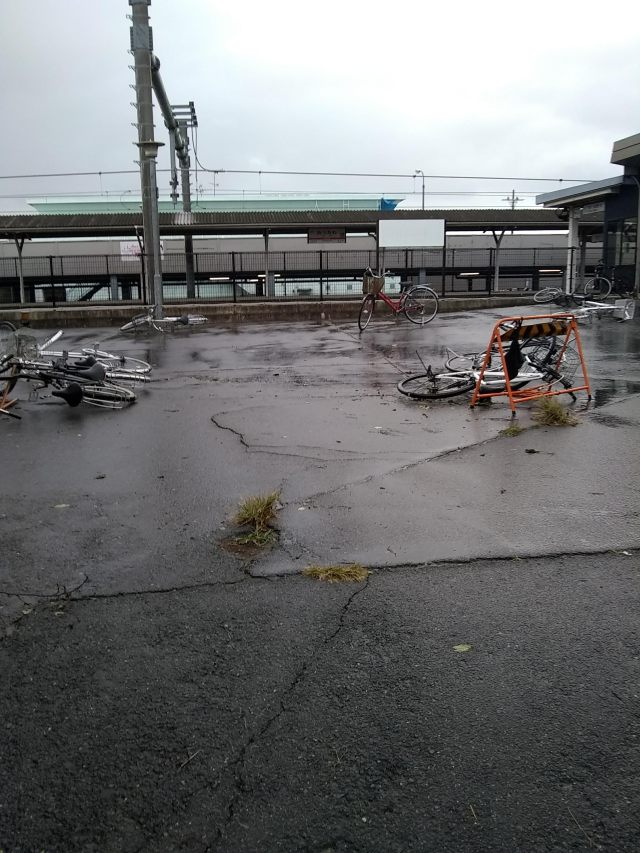
I usually go to bed fairly early, around 9 or 10. I’m an early to bed – early to rise kind of person. So, when my alarm went off at 6 am the next day for school, suffice it to say I was a little disappointed that the typhoon didn’t cause a cancellation. However, the classic adage came true, I should have been careful what I wished for. Something felt off as soon as I began to walk up the hill to the train station. It was a lot less crowded than usual, in fact, no one but a couple of workers in orange safety vests was there. The station itself looked a little worse for wear, with rows upon rows of bikes knocked over. As I approached the turnstile an automated message played. It was all in Japanese but I was certain it said something like “we’re sorry for any inconvenience.” A quick google search in English confirmed that yes, many many JR trains were delayed or canceled due to the typhoon. Although school was still in session for the day, I would have to request an excused absence.

img_20181001_071436965

I still went to campus after the trains started up again even though I had missed my class. I had some administrative things to take care of. I’m glad I’m not psychic because I would have shirked those responsibilities if I had known what the commute had in store. Although the trains were working again, the schedules were completely messed up. It usually takes me somewhere between an hour and fifteen minutes and an hour and a half for my commute. It took me over two and a half hours to get back home. I’m pretty sure I spent more time commuting then I did on campus that day.  Anyway, that was my experience with Typhoon 24 (Trami).

PRO TIPS:

  1. Typhoons are numbered in Japan. It’s really hard to find local news if you type the name given to Typhoons. If you’re ever in Japan trying to get the latest information, find out what it’s number is and search for that.
  2. In general, western news sources are going to be alarmist and not up to date. It might feel convenient to turn to these sources ー just a quick google search away! ー but it really isn’t. Where can you find information than as an English speaker in Japan? Japan Meteorological Agency! They have all sorts of information not just for typhoons, but all natural disasters one might want to be up to date on (and just daily weather patterns, too). It’s comprehensive and entirely in English. I really wish I had found this website earlier in the day when Typhoon 24 hit. But now I have it as a resource if need be in the future.


An Introduction

Hello family, friends, and hopefully many others. This is – clearly – the first post of my blog which I am writing both for fun and obligation for a scholarship (more on that later in its own post).

For those tuning into my life for the very first time, allow me to introduce myself. I am Winter, a student at the University of Massachusetts Amherst and I am spending my junior year studying abroad at Nanzan University (南山大学) in Nagoya, Japan.

This year is very exciting for me – not only will it be highly influential in my area of study, Japanese language, but it is also something I’ve been working towards for most of my life. I have been interested in Japan’s language and culture from a young age, and finally being able to come to the country and study both of those is a feeling of such gratitude and happiness I struggle to put it into words. I look forward to sharing this year with all of you!