Last week, I rode the shinkansen, Japanese bullet train, for the first time. I figured it would be a pretty straightforward process, and it is, but there are definitely a few things that I wish I knew in advance. Actually, just one thing. And then a bunch of other things I had to google in order to have the knowledge in advance. So, for anyone else searching for that knowledge, here’s my take it on it.
Before I dive in, this is going to be about buying tickets in Japan and how to use the tickets. For those coming from overseas just to sightsee, you have the option of purchasing a Japan Rail Pass. The exact price varies depending on location and how many days, with the average being around 200 USD for seven days. These passes are through the different JR (Japan Rail) companies and cover almost all JR trains and buses (note that city subways are NOT operated by JR). My one-way shinkansen ticket from Nagoya to Shin-Osaka was almost 6000円 (~$55), so if you’re planning cover a lot of ground it definitely is worth it! More information can be found here.
Buying a Ticket:
This is one thing I researched myself, and the advice I’m about to give is contrary to what I found others suggesting. However, I am of the opinion that the easiest way to buy a shinkansen ticket is at a machine and not at a counter with a person. Especially if you do some prior planning with a Japan transit app. The main reason that I found other people recommending going to a person is because of “how confusing” shinkansen can be, but I would like to dispel this rumor. There are only three simple things you need to know before approaching a ticket machine:
1) Names of shinkansen:
When using a transit planner you’ll see something like this:
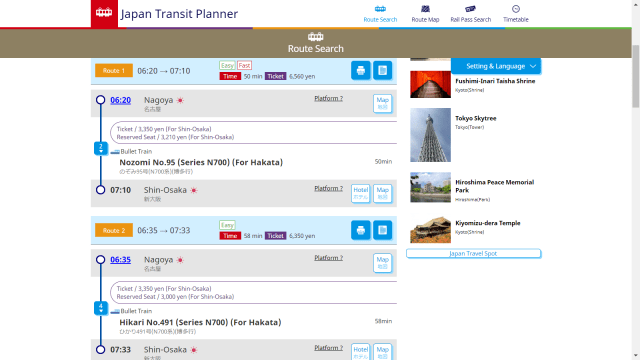
As you can see, both of these options are on a bullet train, but one of them says “Nozomi No. 95” and the other says “Hikari No. 491”. Depending on where you’re going, you may see a variety of other names, but the difference remains the same: speed and price. If you compare the two, the Nozomi train makes two stops less and gets in 23 minutes earlier. If you want a reserved seat it’s 210円 more, but non-reserved seats are the same price for both trains.
2) Seats:
Seats come in three kinds: reserved, non-reserved, and green car. Reserved means just that, you reserve an actual seat and are guaranteed to sit in it. Non-reserved means that the seats in that cabin are first-come-first-served, and you might end up standing. These tickets are the cheapest. Green car is code for first class, where there is more room per seat and fewer people in general, but the difference in price can be 2-3000円 more.
3) Do you want to ride in a smoking or non-smoking car?
Once you know what ticket you want to buy, approach a shinkansen ticket machine. These can be found in any train station where you can board a shinkansen, and even some bigger stations where you can’t, for example, there’s a couple in Nagoya’s Kanayama station. At a shinkansen ticket machine, you can, of course, buy shinkansen tickets, but also transfer tickets to JR limited express trains. These are a little nicer than your average JR train and require an additional seat fee. Much like shinkansen you can buy a reserved or unreserved seat. I mention this because when I bought my ticket I also bought a transfer ticket for a limited express train. Once at the machine, there’s a button on the top right of the screen to change the language. You’ll then be given the choice of searching for a reserved shinkansen ticket, a non-reserved ticket, or to purchase tickets using a route search. I believe if you search for a reserved or non-reserved ticket you will be asked if you want to buy a transfer ticket as well, but I just chose to use the route search. With that option, you input the starting station and final station – for me, this was Nagoya and Kii-Tanabe – dates, and time. It will then show you some itinerary options, pick the one that works best for you, or if you’re using a transit app, matches that itinerary. Pay with a credit card or cash and receive your tickets!
You will always receive at least two tickets, there will be more if you bought transfer tickets as well. One of these will be your “ticket”, which is the cost of getting from point a to point b. My ticket read Nagoya to Kii-Tanabe. The other ticket(s) is your seat ticket, this is the cost of being on the train. Because I transferred, I had two separate seat tickets, one for a shinkansen from Nagoya to Shin-Osaka, and one for a JR limited express from Shin-Osaka to Kii-Tanabe.
Riding the Shinkansen:
This is the part that messed me up on my travels. It’s super straight forward if you know what to do, but if you don’t then a ticket machine will yell at you. And the businessmen trying to have an easy commute will be annoyed at you when you have to push past them to ask a station attendant why you can’t get through.
Anyway, what you do is you take your ticket, and your seat ticket, and put them stacked on top of each other into the ticket machine. Now the gates will let you through and spit the tickets out on the other side, where you collect them. Then, as you exit at the end of your trip, just repeat this process. Unless you’re transferring, then you add your new seat ticket onto the pile and put all three into the machine, this time it will only spit back your new seat ticket and fare ticket.
As for actually riding the shinkansen, find either the car number your reserved ticket corresponds to or a car marked “non-reserved.” If you do have a non-reserved ticket, I recommend arriving early so that you can be near the front of the line and have a better chance of getting a seat. The seats have a very large amount of legroom, designed for anyone traveling with a large suitcase to be able to fit that in front of them. If you’re not traveling with one, enjoy the room!
And that’s all! Happy travels!


I will file away for the future , love it
Sent from my iPhone
>
LikeLiked by 1 person